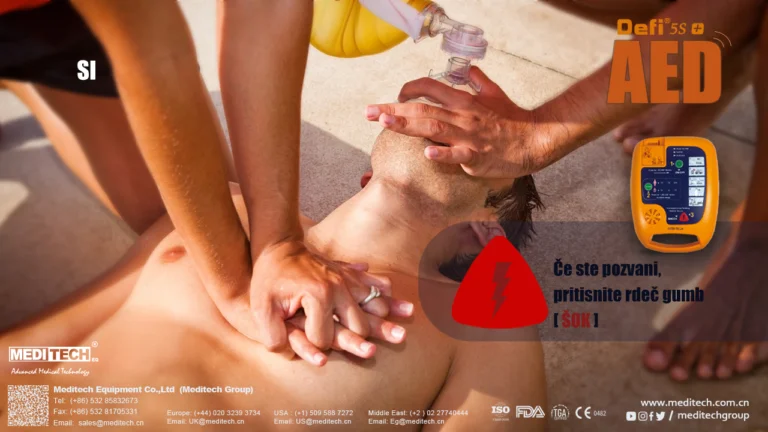
Defibrillator Defibrillator is a device used to perform Defibrillation for the purpose of turning abnormal ECG rhythm into normal rhythm
Defibrillator
Defibrillator is a device used to perform Defibrillation for the purpose of turning abnormal ECG rhythm into normal rhythm. When heart enters into ventricular fibrillation, the process of returning it to its normal sinus rhythm by giving proper amount of external electric current is called Defibrillation, and device used in giving such electric current is called Defibrillator. Should electrical energy is given in the form of shocks, it creates stimulation namely, myocardium is depolarized and systole occurs. To give shock to heart by means of Defibrillator, heart should be in ventricular fibrillation or ventricular tachycardia rhythm without pulse.
A Defibrillator is an electrical device that provides a shock to the heart when there is a life-threatening arrhythmia present. The arrhythmia that we worry Über is called ventricular fibrillation. This is a very rapid erratic beating of the heart. Multiple parts of pacemakers in the heart starts sort of beating erratically and the heart can’t rhythmically contract. And what the Defibrillator does, it provides shock that basically shocks the heart to stop so that it can start rhythmically contracting again.
Defibrillation is a procedure used to treat life threatening conditions that affect the rhythm of the heart such as kardial arrhythmia, ventricular fibrillation and pulseless ventricular tachycardia.
The procedure involves the delivery of an electric shock to the heart which causes depolarisation of the heart muscles and re-establishes normal conduction of the heart’s electrical impulse. The machine used to deliver this therapeutic shock to the heart is called a Defibrillator.
Understanding Defibrillation Waveforms
Before we start, let’s define a few terms:
Energy: Energy in a Defibrillator is expressed in joules. A joule is the unit of work associated with one amp of current passed through one ohm of resistance for one second.
When we express it in a formula, it is generally stated as follows:
Joules (Energy) = Voltage X Current X Time
Joules have become a surrogate for current in modern Defibrillator Sprache.
Current: Current is what actually defibrillates the heart. It is also expressed as Voltage/Impedance (resistance).
Impedance: Resistance to Flow; there is resistance in the electrical circuit itself as well as in the patient. The amount of impedance in a patient is difficult to determine as it relates to body mass, temperature, diaphoresis Qualität of the Kontakt with paddles or pads. Impedance is expressed in ohms.
Monophasic Waveforms: A type of Defibrillation Wellenform where a shock is delivered to the heart from one vector as shown below. It is shown graphically as current vs. time.
In this Wellenform, there is no ability to adjust for patient impedance, and it is generally recommended that all monophasic Defibrillatoren deliver 360J of energy in Erwachsene patients to insure maximum current is delivered in the face of an inability to detect patient impedance.
biphasische Defibrillation
Unlike conventional monophasic Defibrillatoren, biphasic Defibrillatoren deliver current in two directions. In the first phase, the current moves from one paddle to the other as with monophasic Defibrillatoren. During the second phase, the current flow reverses direction. The underlying physiologic mechanisms aren’t fully understood yet, but it is clear that biphasic waveforms lower the electrical threshold for successful Defibrillation. The shape of the current’s delivery is determined by the current, direction of energy and duration of the delivered energy. Animal research has demonstrated that the most effective waveforms maintain their shape and duration regardless of patient impedance. Biphasic waveforms adjust for impedance by varying the characteristics of the waveforms. This is intended to ensure that high-impedance persons will have the same chance for survival as those who are of low impedance.
biphasische Defibrillation offers equal or better efficacy at lower energies than traditional monophasic Wellenform Defibrillatoren, with less risk of post-shock complications such as myocardial dysfunction and skin burns. This is why almost all manufacturers of external Defibrillatoren are now using biphasic waveforms in their devices
What is Biphasic Wellenform?
biphasischer Defibrillator gives bilateral current as to be positive and negative after its electrical energy is discharged. Namely, it conducts electrical current bilaterally. On the first phase, current flows from one electron to the other as it is in monophasic Defibrillator. On the second phase, current starts to flow on reverse direction. According to the studies done, it is observed that biphasic waves produce more successful Defibrillation with lower energy than monophasic waves and so they are less harmful. In addition, since same results can be obtained with low energy use, some adverse effects such as burns are also reduced.
What is the difference between a monophasic and biphasischer Defibrillator?
Defibrillator is a device used to shock the heart back into action when it stops contracting due to a disorder of the rhythm known as ventricular fibrillation (VF). The electrodes used to deliver the shock could be either Defibrillator paddles or patches, directly applied to the chest below the left collar bone and at the apex of the heart.
The direct current shock given can have a monophasic or biphasic wave form. In monophasic shock, the shock is given in only one direction from one electrode to the other. In a biphasic shock, initially direction of shock is reversed by changing the polarity of the electrodes in the latter part of the shock being delivered. Usually the initial voltage applied is higher than the reversed polarity shock. Biphasic wave forms were initially developed for use in implantable cardioverter Defibrillatoren (ICD) and later adapted to external Defibrillatoren. Biphasic truncated exponential wave form and rectilinear biphasic Wellenform are two types of biphasic waveforms used by different manufacturers. Defibrillatoren can sense the thoracic impedance and increase or decrease their internal resistance so that the selected level of energy is delivered to the subject.
Biphasic shocks are more effective than monophasic shocks and need lesser energy. Typically when 360 Joules are delivered for Defibrillation in a monophasic Defibrillator, 200 Joules are given in a biphasischer Defibrillator. This could theoretically reduce the potential damage to the heart muscle by the high voltage shock.
How to use a Defibrillator?
Defibrillatoren are the devices used to deliver shocks to the heart in cases of life threatening kardial disorders. Electrodes that are connected to the machine are usually held in place over the chest of a patient while one or more shocks are delivered.
Defibrillatoren are used to re-establish a normal heart rhythm in cases of kardial arrhythmia, ventricular fibrillation and pulseless ventricular tachycardia.
The chest of the patient is cleared of any clothing or jewellery and adhesive or metal electrodes are applied to the chest. These electrodes are connected to the Defibrillator.
Adhesive gel electrodes are commonly used with the automated and semi-automated units used in ambulance or non-Krankenhaus settings due to their ease of Anwendung. These adhesive gel electrodes are available in solid-gel and wet-gel forms, with solid-gel electrodes the easier to use of the two, as there is no need to clean the patient’s skin after removing the electrodes.
These electrodes, however, may burn the skin, whereas wet-gel electrodes can spread the current more uniformly. The adhesive patches are also safer for Gesundheitswesen personnel to use due to the very low risk of the operator coming into Kontakt with the electrode. The operator can stand several feet away from the patient. Furthermore, the adhesive patches require no force of Anwendung, while approximately 25 lbs of force is erforderlich to apply the metal electrodes.
Operating a manuell Defibrillator (cardioverter) requires familiarity with the equipment at hand. There are many types of manuell Defibrillatoren, each with differences, such as what the Monitor face and controls look like and what type of self-adhesive Defibrillation pads are used. These differences in equipment can lead to significant delays in Versorgung resulting in poor outcomes for patients experiencing kardial arrest. If you anticipate having to operate a manuell Defibrillator, know what equipment will be available to you ahead of time.
Prepare the Equipment
Place Defibrillator on a solid, dry surface.
Turn on the manuell Defibrillator. Depending on the model, there might be a dial to turn or a power button to push. Defibrillatoren have Akkus and should be fully charged. If the Defibrillator-Monitor shows low Akku output, plug the Defibrillator into a power source, or obtain another manuell Defibrillator.
Insert the connecting cables into the receptor on the manuell Defibrillator.
Attach the self-adhesive Defibrillation pads to the connecting cable leads.
Apply Paddles or Self-Adhesive Defibrillation Pads
Remove self-adhesive Defibrillation pads from packaging and connect pads to conducting cables. If using paddles, connect paddles to Monitor by inserting adapter into receiving port identified on the manuell Defibrillator.
Apply conducting gel to paddles or ensure that self-adhesive Defibrillation pads are moist with sufficient conducting medium. If the pads were not properly sealed in the packaging, the conducting gel may dry out and not perform properly. In this case, get a new set of pads.
Apply paddles/pads to the chest. There are two placement options for defibrillating. With paddles, use the anterolateral placement. If using a manuell Defibrillator with self-adhesive pads, the anteroposterior is preferred, but if a patient cannot be moved, or it is difficult to reach the patient’s back, use anterolateral placement.
1) Anterolateral: one paddle/pad is placed to the right of the upper sternum, below the clavicle (collar bone) and one paddle/pad is placed to the left of the left nipple with the center of the paddle/pad in the midaxillary line (imagine a line extending down from the middle of the arm pit.)
2) Anteroposterior: One paddle/pad is placed over the left side of the chest, below the clavicle and the other is placed on the left side of the back below the shoulder blade and to the left of the spine
Defibrillate
Set the energy level for electrical discharge.
There are two types of manuell Defibrillatoren: biphasic or monophasic.
1) Biphasic Wellenform devices have device-specific energy levels that are indicated on the Defibrillator. If you do not know the device specifics, the default initial energy setting is 200 joules (J).
2) Monophasic Wellenform device energy setting is 360 J for all Defibrillation attempts.
Press the “charge” button on the manuell Defibrillator. If you are using paddles, there also is a charge button on the paddles.
Discharge the Defibrillator by pressing the “shock” button on the manuell Defibrillator or, if using paddles, the discharge button on the paddles.
What is a tragbar Defibrillator?
A tragbar Defibrillator is just what it is stated as; it is a Defibrillator that is tragbar and can be carried around. This machine is no longer solely found in an Notfall vehicle or a Krankenhaus, but it can be purchased for use at Startseite. If you or your loved one is at risk for a heart attack, this may be an option for Versorgung in order to prolong the Qualität of life. A tragbar Defibrillator is konzipiert to detect the irregular heartbeat and provide the erforderlich amount of electricity in order to make the heart beat normally again. The Technologie of these devices is remarkable, because it does not provide too much or too little electricity.
A tragbar Defibrillator is a erforderlich necessity to save a person who is experiencing sudden kardial arrest. Sudden kardial arrest is not a heart attack. Many people confuse the two as being one and the same, but they are drastically different. The only common denominator between a heart attack and sudden kardial arrest is, they both involve malfunction of the heart. The heart requires blood from the arteries. When these arteries become blocked and damaged that oxygen supply is hindered the tissues become damaged. A heart attack occurs when one or more arteries become clogged and the heart is not receiving the oxygen it needs.
Sudden kardial arrest syndrome on the other hand is not a result of damaged or clogged arteries but is more a result of an electrical malfunction in the heart and this can happen to anyone at anytime. There are no preexisting illnesses or symptoms to accommodate SCA. However, many heart attack victims have also suffered SCA during their heart attack. When SCA does occur, there is only one zuverlässig response that can save lives, and that is a Defibrillator. Not all public places are equipped with Defibrillatoren, which is why a tragbar Defibrillator is an important machine for everyone to own.
A tragbar Defibrillator is a small tragbar machine that works just like any other medical Defibrillator. If a tragbar Defibrillator is readily handy, response can be immediate. A tragbar Defibrillator can be used by anyone, although it is recommended that someone who purchase a tragbar Defibrillator be trained. Defibrillatoren are easy to use and not intimidating.
When a person experiences SCA, there are literally moments to respond. With a tragbar Defibrillator, that response can be instant. At the onset of of symptoms, CPR should be given immediately. The tragbar Defibrillator should be turned on and instructions should be followed. The pads are placed on the victim’s chest and the machine will begin to analyze the heart. The machine will determine if the heart needs a shock, and how much shock is erforderlich. Once the shock is released , the machine will determine if another shock is erforderlich. If another shock is erforderlich, the tragbar Defibrillator will react accordingly. The Defibrillator shocks the heart back to a normal rhythm pattern altering the destructive course that SCA set the heart upon.
tragbar Defibrillatoren come in different models, types and with various Merkmale. Many potential tragbar Defibrillator users require the voice-activated Merkmal, which provides detailed instructions to the user so no mistakes are made. You can also purchase a refurbished tragbar Defibrillator for a more affordable price.
Defibrillatoren are the only available device to save the life of a person experiencing sudden kardial arrest. When a person suffers from SCA, there is not enough time to transport them to a Krankenhaus for Behandlung, or to a location where a Defibrillator might be available. By having a tragbar Defibrillator, you treat a person anytime, anywhere. A tragbar Defibrillator should be readily carried like a first aid kit. Nobody knows when sudden kardial arrest will occur, and to be prepared is to save lives.
How an External Defibrillator Works?
As already discussed, the heart is a very important organ. When the heart gets worn out from age or is damaged for some other reason, it becomes susceptible to failure. This failure is usually called a “heart attack.” What happens during a heart attack is that a blockage of the vessels of the heart or a failure of heart muscle to contract leads to the signal sent to the heart telling it to beat is disrupted. This disruption in the signal to the heart leads to the signal not being sent properly the Weiter beat (note the heart beats Über once per second), which ultimately leads to heart failure and death.
One of the only ways doctors have been able to restart the heart after an event like this happens is by way of an external Defibrillator. These are machines that work to reverse a heart failure symptom called fibrillation. The external Defibrillator “shocks” the heart in a way and works to reset the signal, allowing the heart to continue to beat, assuming the damage to the heart by the blockage or muscle death isn’t too severe.
What is a Defibrillator Machine?
A Defibrillator machine is a tool that essentially “shocks” a patient back to life. Obviously, it is more complicated than that, but it is still a fairly präzise statement. The heart is the organ in a human that transports nutrients from the head all the way down to the toes and ensures our cells continue to live and Funktion. The heart does this by beating and acting as a pump. When the signal to tell it to beat, which is sent by pacemaker cells in the heart, gets ‘out of whack’, kardial arrest can occur. To reset these pacemaker cells and make sure they continue to beat as they should, a Defibrillator machine can be used. It is called Defibrillator because it fixes a condition during hard failure called fibrillation. So as the Name goes, it de-fibrillates!